Wednesday, November 4, 2009

Giving Back Fund Releases 2009's Top Celebrity Givers

Look To The Stars is proud to announce that our partners at the Giving Back Fund have announced their third annual Giving Back 30, a list of celebrities who have made the largest donations to charity according to public records.

Readers may have been surprised to learn that Paul Newman replaced Oprah Winfrey as the most generous celebrity of 2008. Oprah had occupied the number one spot by a wide margin for the first two years of the list.

Before his death, Newman made a donation of nearly $21 million to his self-named Newman’s Own Foundation. Angelina Jolie and Brad Pitt were second with a $13.5 million donation to the Jolie-Pitt Foundation, which distributed $6.4 million to charity, including a $2 million grant to The Global Health Committee for an Ethiopian clinic project, a $1 million grant to the Make it Right Foundation founded by Pitt, and $500,000 to the Armed Services YMCA USA.

“Our hope is that celebrities will begin to become more comfortable sharing information about their charitable giving - perhaps not disclosing everything they give, but sharing enough to enable them to serve as role-models to their peers and fans,” said Marc Pollick, President and Founder of The Giving Back Fund.

Also on the list: Oprah Winfrey, Will Smith and Jada Pinkett Smith, Mel Gibson, Leonardo DiCaprio, Laurie and Larry David and Drew Barrymore. Several authors made the list this year, along with representatives from the NBA, NFL and NASCAR. To see the complete list visit The Giving Back Fund’s web site at www.givingback.org.

HOW IT WAS COMPILED

To compile the most accurate rankings, The Giving Back Fund culled media reports of charitable giving by sports and entertainment professionals; reviewed PF-990 tax-forms; contacted more than 250 publicists, attorneys, agents, agencies, and managers for information about their clients; polled more than 150 charities known for their celebrity associations; and contacted all of the major sports leagues.

The Giving Back Fund did not include grants made by foundations in the list so as to avoid counting the same funds twice - once when the donor gave money to a foundation and again when the donor decided on a beneficiary for that money. The Giving Back Fund did not calculate giving as a percentage of the celebrities’ income because there are no public records documenting income. Re-directed income from sponsorship and merchandising deals to charity made by a celebrity was also not reported as it is not available to the public.


Donations to private foundations are disclosed in public documents. However, donations to public charities are not publicly disclosed and therefore may not be reported in the Giving Back 30.

Charity Times Awards 2009

The Charity Times Awards reached a landmark tenth year in 2009, and this year's event was the biggest ever.

This year's shortlist and winners are below.


The 2009 Shortlist and Winners

Charity of the Year:

Chance UK
Deaf Parenting UK
Five Talents
International HIV/Aids Alliance
Leeds survivor Led Crisis Service
Solaraid
Storybook Dads
Teach First
The Relationship Centre

Winner: Leeds Survivor Led Crisis Service

The winner showed clear evidence of how a smaller charity can make a real difference and have substantial benefits on the ground.


Best New Charity:

FibroAction
Live Life Then Give Life
Lively Minds
Ostomy Lifestyle

Winner: Live Life Then Give Life
An inspirational new charity, whose vision, commitment, passion and professionalism shines through.

Highly commended: Ostomy Lifestyle


Charity Principal of the Year:

Catriona McPhee-Smith, CEO, Inspire
Ed Bracher, CEO, Riding for the Disabled Association
Emma Jayne Cross, CEO, Beatbullying
Dilowar Hussain Khan, executive director, East London Mosque and London Muslim Centre
Jane Davis, Director, The Reader Organisation
Jeanette Allen, CEO, MedicAlert Foundation
Howard Sinclair, CEO, Broadway Homelessness & Support
Steve Kirk, CEO, St Lukes Hospice

Winner: Emma Jayne Cross, CEO, Beatbullying

An outstanding, committed individual, her passion for her work is inspiration to all in the sector.


Best Charity to Work for

Inspire
P3
Save the Children UK
Tyneside Cyrenian

Winner: Save the Children UK


Outstanding Individual Achievement:

Alison McCausland, Co-founder, The Relationship Centre
Karen Pollock, CEO, Holocaust Educational Trust
Marc Koska, Founder, The Safepoint Trust
Michele Elliott, Founder, Kidscape
Sabina Iqbal, chair and founder, Deaf Parenting
Sadruzzaman Khan, Chair, Asian Social& Humanitarian Association
Sharon Beckett, CEO, Gwent Association for the Blind

Winner: Alison Mcausland, Co-founder, The Relationship Centre

She has made a real impact in a challenging area and without having the resources of a larger charity.


Human Resources Team of the Year:

Breakthrough Breast Cancer
Broadway Homeless and Support
Diabetes UK
Edinburgh Cyrenians

Winner: Breakthrough Breast Cancer

A clear focused HR strategy, which has reaped obvious benefits for the charity as whole.


Fundraising Team of the Year:

Breast Cancer Care
British Heart Foundation
Community Foundation for Merseyside
Havens Hospices
The Childrens Trust

Winner: The Childrens Trust

A clear fundraising focus and vision for how to achieve their much needed project finance.


Campaigning Team of the Year:

Action For Children
Bliss
British Heart Foundation
Macmillan Cancer Support
ITV Fixers
The National Autistic Society
Women's Aid

Winner: The National Autistic Society

To campaign for, and be successful in achieving an Autism Bill, is a major achievement of the highest order. The campaign cannot be commended enough.


Trustee Board of the Year:

Broadway Homelessness & Support
East London Mosque and London Muslim Centre
Juvenile Diabetes Research Foundation
Tyneside Rape Crisis Centre

Winner: Broadway Homelessness & Support

Solid, robust trustee professionalism at its very best.


Best Use of Technology:

Anchor House
Comic Relief
Humber Learning Consortium
National Day Nurseries and Virtual College
The Brendoncare Foundation
South Bucks Hospice

Winner: Anchor House

Anchor House has given us a fantastic example of how the power of technology can be harnessed to make people’s lives better. IT is being used to make Anchor House more secure, to give residents more independence and to provide them with better access to information. Very well done.


Best Use of the Web:

CyberMentors (Beatbullying)
Disabled Living Foundation
Teacher Support Network
Tearfund
Rafi.KI
United Response
WWF

Winner: Teacher Support

Teacher addresses a critical need. The site has a great architecture with interactive content served upfront. You can sense the passion behind this site, in spite of a modest budget. The judges admired the written entry submission which was passionate and clear and the grreat use of social networking tools.


Corporate National Partnership of the Year:

Breast Cancer Care/QVC UK
Caudwell Children/Barclays Wealth
Childrens Hospice UK/Barclays Commercial
Live Music Now/ Bank of America
Meningitis Trust/Focus DIY
National Day Nurseries Association/Virtual College
Read International/Big Yellow Storage

Winner: Meningitis Trust/Focus DIY

A strong spirit of partnership is evident, built up over many years and without any big promotional headlines.


Corporate Community Local Involvement:

Action For Children/Barclays
Broadway Homelessness and Support/United House
Hammersmith and Fulham Volunteer Centre/The Walt Disney Company
Help the Aged/ Barclays
Rangers Charity Foundation

Winner: Action For Children/Barclays

A good community involvement in the most practical but useful of ways in the recession


Corporate Social Responsibility Project of the Year:

Carluccios and Action Against Hunger UK
Panasonic Europe
SolarAid
The British Forces Foundation and British Airways

Winner: SolarAid

A clear but innovative approach that showed real obvious benefits

Highly commended: Carluccios and Action Against Hunger UK

An excellent example of CSR at work


Banking Services:

Charity Bank
The Co-operative Bank
Unity Trust Bank

Winner: Unity Trust Bank

A clear commitment to the ethics of the charity sector is clear in its business model


Investment Management:

Barings
Collins Stewart
JP Morgan
Rathbones

Winner: Rathbones

Solid investment expertise mixed with a real commitment to the charity sector


ICT Services:

IRIS NFP Solutions
IP Solutions

Winner: IRIS NFP Solutions

Although a large, established company offering a range of solutions for different markets the judges were impressed by the detail of the submission and were particularly impressed that they have made the systems really accessible to the not-for-profit sector.


Accountancy Services:

Haysmacintyre

HW Fisher & Company

Winner: Haysmacintyre

A good account of how to serve the sector and improve its service according to the needs


Insurance Services:

Access Underwriting

Zurich

Winner: Zurich

A clear commitment to the charity sector through its services and focus on corporate responsibility.


The Charity Times Awards continue to be the pre-eminent celebration of best practice in the UK charity and not-for-profit sector.

The 2009 Awards included extra categories to reflect the changing nature of the sector.

The awards recognise that it is the leaders within charities who are responsible for coordinating much of the charitable activity throughout the UK and as the engines of the charity sector, it is at this level that the Awards are targeted.

As such, the event itself is built around the individuals and teams for whom the Awards are intended: trustees, chief executives, directors and other upper-level management from not-for-profits across the UK.

Reflecting this belief, the Awards provides the charity sector with a dedicated event to reward the work carried out in difficult and competitive conditions, and establishes a unique annual congress of the pre-eminent figures in the sector at the premier charity event of the year.

Golf day puts boost in charity’s finances

I had a splendid lunch on Friday in the elegant setting of the Berkshire Golf Club, courtesy of The Alexandra Rose Charities, who were holding a charity auction.

The event was a roaring success, with all the 18 teams enjoying their round of golf on Berkshire’s impressive 18-hole course, but the recession was evident in the difficulty the charming auctioneer Fabian Hine had in raising the amount on some of the auctions.

That said, the total raised for the day was over £10,500. Not bad for the recession. Alexandra Rose Charities national director Margaret Stock was naturally happy with the day, and dug into her first glass of wine late in the afternoon as celebration.

The charity helps charities and community organisations, which aim to advance and improve the quality of life for those with physical, sensory, mental health and learning disability, helping them to raise funds.

The current captain of the Berkshire, Iain Mathewson – who had many complementary words to say about Acevo’s CEO Stephen Bubb, from his days as a civil servant – followed in the clubs’ traditional support of the charity and brought his own team.

Other teams were made up from City Investment Bankers, Beadles of Livery Halls and a team with a charity minded London cab driver who supports the Wilderness Foundation.

I helped out the journalism way, by putting my £10 into the charity’s envelope, and then went on to drink all the wine.

Charity in Truth, a Synthesis

(07 Jul 09 - RV) Pope Benedict XVI's long awaited third encyclical was presented today during a press conference in the Holy See Press Office. Below we publish a synthesis of the themes at the heart of the Papal document:
“Charity in truth, to which Jesus Christ bore witness” is “the principal driving force behind the authentic development of every person and of all humanity”: thus begins Caritas in Veritate, the Encyclical addressed to the Catholic world and “to all people of good will”. In the Introduction, the Pope reminds us that “charity is at the heart of the Church’s social doctrine”. On the other hand, given “the risk of being misinterpreted, detached from ethical living”, it is linked with truth. And cautions us: “A Christianity of charity without truth would be more or less interchangeable with a pool of good sentiments, helpful for social cohesion, but of little relevance” (§ 1-4).
Truth is necessary for development. Without it, says the Pope, “the social action ends up serving private interests and the logic of power, resulting in social fragmentation” (§ 5). Benedict XVI dwells upon two “criteria that govern moral action” that come from the “charity in truth” principle: Justice and the common good. Every Christian is called to love through an “institutional path” which has an incidence on the life of the pólis, of life in society (§ 6-7). The Church, he insists, “does not have technical solutions to offer”; however, she has “a mission of truth to accomplish” for “a society that is attuned to man, to his dignity, to his vocation” (§ 8-9).
The first chapter of the document is about Paul VI’s Message of Populorum Progressio. “Without the perspective of eternal life – the Pope warns us – human progress in this world is denied breathing-space”. Without God, development becomes negative, “dehumanized” (§ 10-12).
Paul VI, one can read, stressed on “the indispensable importance of the Gospel for building a society according to freedom and justice” (§ 13) In Humanae Vitae, Paul VI “shows the strong ties between life ethics and social ethics” (§ 14-15). He explains the concept of vocation in Populorum Progressio. “Development is vocation” because “it derives from a transcendent call”. He goes on to underline that it is thus “integral”, that is, it has to “promote the good of every man and of the whole man”. “Faith – he adds – does not rely on privilege or positions of power”, “but only on Christ” (§ 16-18). Paul VI shows that “the causes of underdevelopment are not primarily of the material order”. They are above all in the will, thought and even more “in the lack of brotherhood among individuals and peoples”. “As society becomes ever more globalized, it makes us neighbours but does not make us brothers”. We must therefore mobilise ourselves, so that economics evolves “towards fully human outcomes” (§ 19-20).

In the second chapter, the Pope deals with Human development in our time. Profit as the exclusive goal “without the common good as its ultimate end, risks destroying wealth and creating poverty”. He goes on to mention some distortions of development: financial dealing that is “largely speculative”, migration of peoples “often provoked” and then insufficiently attended to, and “the unregulated exploitation of the earth’s resources”. Before such interconnected problems, the Pope calls for “a new humanistic synthesis”. The crisis “obliges us to re-plan our journey” (§ 21).
Development today, says the Pope, “has many overlapping layers”. “The world’s wealth is growing in absolute terms, but inequalities are on the increase”, with new forms of poverty emerging. Corruption, he fears, is present in countries rich and poor; too often, multinational enterprises do not respect the rights of the workers. Besides, “international aids has often been diverted from its proper ends, through irresponsible actions” both of donors and of beneficiaries. At the same time, says the Pope, “there is excessive zeal for protecting knowledge on the part of rich countries, through an unduly rigid assertion of the right to intellectual property, especially in the field of health care” (§ 22).
Since the end of the “blocs”, John Paul II had been asking for a global “re-examination of development”, but this “has been achieved only in part”. There is today “a re-evaluation” of the roles of the “State’s public authorities”, and one can foresee an increase in the “political participation in civil society, nationally and internationally”. The Pope then turns his attention to the search, by rich countries, for areas in which to outsource production at low cost. “These processes have led to a downsizing of social security systems”, with “grave danger for the rights of workers”. To this, one has to add that “the cuts in social spending, often made under pressure from international financial institutions, can leave citizens powerless in the face of old and new risks”. In any case, one can observe that “governments, for reasons of economic utility, often limit the freedom of labour unions”. Those who rule are reminded that “the primary capital to be safeguarded and valued is man, the human person in his or her integrity” (§ 23-25).
On a cultural level, the possibility of interaction opens new perspectives of dialogue, but with a double danger. First, there can be a cultural eclecticism in which all cultures are viewed as “substantially equivalent”. The opposite danger is that of “cultural levelling”, “the indiscriminate acceptance of types of conduct and life-styles” (§ 26). The Pope then turns his attention to the scandal that hunger represents. What is missing is a “network of economic institutions” capable of confronting this emergency. One must hope for “new possibilities” in the techniques of agriculture and land reform in developing countries (§ 27).
Benedict XVI then underlines that the respect for life “cannot in any way be detached” from the development of peoples. Various parts of the world still experience practices of demographic control which “go as far as to impose abortion”. In economically developed countries, there is “an anti-birth mentality, frequent attempts (being) made to export this mentality to other States as if it were a form of cultural progress”. In addition, there is “reason to suspect that development aid is sometimes linked” to “specific healthcare policies which de facto involve the imposition” of birth control. The “laws permitting euthanasia” are another matter for concern. “When a society moves towards the denial or suppression of life, it ends up no longer finding the necessary motivation and energy to strive for man’s true good” (§ 28).
There is another aspect connected to development: the right to religious freedom. Violence “puts the brakes on authentic development”, and this “applies especially to terrorism motivated by fundamentalism”. At the same time, promotion of atheism in many countries “obstructs the requirements for the development of peoples, depriving them of spiritual and human resources” (§ 29). For development needs the interaction of the various levels of knowledge, put in harmony through charity (§ 30-31). One must hope that the economic choices continue “to prioritize the goal of access to steady employment” for everyone. Benedict XVI warns us against “short-term – sometimes very short-term – economy, which leads to “lowering the level of protection accorded to the rights of workers” in order to “increase the country’s international competitiveness”. For this, he exhorts us to correct some dysfunctions of the development models as is required today by the “earth’s state of ecological health”. He concludes with globalization: “Without the guidance of charity in truth, this global force could cause unprecedented damage and create new divisions”. Therefore, we have to deal with “a new and creative challenge” (§ 32-33).

Fraternity, economic Development and civil society is the theme of the 3rd chapter of the Encyclical, opening with a praise of the experience of giving, often unrecognised “because of a purely consumerist and utilitarian view of life”. The conviction that economics are free from the “influences of a moral character” “has led man to abuse the economic process in a thoroughly destructive way”. Development, “if it is to be authentically human”, must “make room for the principle of gratuitousness” (§ 34). This is particularly relevant regarding the market.
“Without internal forms of solidarity and mutual trust, the market cannot completely fulfil its proper economic function”. The market “cannot rely only on itself”, it “must draw its moral energies from other subjects” and must not consider the poor as a “burden, but a resource”. The market must not become “the place where the strong subdue the weak”. Commercial logic needs to be “directed towards the pursuit of the common good, for which the political community in particular must also take responsibility”. The market is not negative by nature. Therefore, what is to be challenged is man, his “moral conscience and responsibility”. The present crisis shows that the “traditional principles of social ethics like transparency, honesty and responsibility cannot be ignored or attenuated”. At the same time, the Pope reminds us that economics do not eliminate the role of the State, and requires “just laws”. Calling to mind Centesimus Annus, he points to the “necessity of a system with three subjects: the market, the State and civil society”, and calls for ways to “civilizing the economy”. We need “economic forms based on solidarity”. The market and politics need “individuals who are open to reciprocal gift” (§ 35-39).

In the 4th chapter, the Encyclical deals with the Development of people, rights and duties, the environment. One can notice the “claims to a ‘right to excess’” in the affluent societies, while food and water are lacking in certain underdeveloped regions. “Individual rights when detached from a framework of duties can run wild”. Rights and duties are in connexion to an ethical context. If, on the other hand, their basis is only “to be found in the deliberations of an assembly of citizens”, they are liable to be “changed at any time”. Governments and international bodies must not forget “the objectivity and ‘inviolability’ of rights” (§ 43). On this matter, one can dwell upon the “problems associated with population growth”. It is a “mistake” to “consider population increase as the primary cause of underdevelopment”. The Pope reaffirms that sexuality cannot be “reduced merely to pleasure or entertainment”. One cannot regulate sexuality through “strategies of mandatory birth control”. He then goes on to underline that “morally responsible openness to life represents a rich social and economic resource”. “States are called to enact policies promoting the centrality and the integrity of the family” (§ 44).
The economy, he adds, needs ethics in order to function correctly – not any ethics whatsoever, but an ethics which is people-centred”. The same centrality of the human person must be the guiding principle “in development programmes” of international cooperation, in which the beneficiaries should always be involved. “International organizations might question the actual effectiveness of their bureaucratic machinery”, “often excessively costly”. The Pope notices that too often “the poor serve to perpetuate expensive bureaucracies”. Hence his call for a “complete transparency” concerning funds received (§ 45-47).
The last paragraphs of the chapter are devoted to the environment. For the believer, nature is a gift of God, to be used in a responsible way. In this context, our attention is brought to consider the energy problem. The fact that some States and power groups “hoard non-renewable energy resources” constitutes “a grave obstacle to development in poor countries”. Therefore, the international community should “find institutional means of regulating the exploitation of non-renewable resources”. “The technologically advanced societies can and must lower their domestic energy consumption”, while at the same time “encourage research into alternative forms of energy”.
Basically, “what is needed is an effective shift in mentality which can lead to the adoption of new life-styles”. A style which, up to now in most parts of the world, “is prone to hedonism and consumerism”. The decisive issue, therefore, is “the overall moral tenor of society”. The Pope goes on to caution: “If there is a lack of respect for the right to life and to a natural death”, “the conscience of society ends up losing the concept of human ecology”, including that of environmental ecology (§ 48-52).
The cooperation of the human family is at the heart of the 5th chapter, in which Benedict XVI shows that “the development of peoples depend above all on a recognition that the human race is a single family”. On the other hand, one can read that the Christian religion can contribute to development “only if God has a place in the public realm”. By “denying the right to profess one’s religion in public”, politics “takes on a domineering and aggressive character”. The Pope warns: “Secularism and fundamentalism exclude the possibility of fruitful dialogue” between reason and religious faith. A breach that “comes only at an enormous price to human development” (§ 53-56).
The Pope then examines the principle of subsidiarity, which offers a help to the human person “via the autonomy of intermediate bodies”. Subsidiarity “is the most effective antidote against any form of all-encompassing welfare state” and is well-suited to direct globalization towards its authentic human development. International aids “can sometimes lock people into a state of dependence”, hence all subjects of the civil society, and not only the rulers, should be involved. “Too often, aid has served to create only fringe markets for the products” of these countries (§ 57-58). The Pope exhorts the economically developed nations to “allocate larger portions” of their gross domestic product to development aid, thus respecting the obligations undertaken. He then advocates a greater access to education and more towards “the complete formation of the person”, for relativism makes everyone poorer. An example is given by the perverse phenomenon of sex tourism. “It is sad to note that this activity takes place with the support of local governments, with silence from those in the tourists’ countries of origin, and with the complicity of many of the tour operators” (§ 59-61).
The Pope then deals with the phenomenon of migration, with “epoch-making” proportions. “No country can be expected to address today’s problems of migration by itself”. Every migrant is “a human person” who “possesses fundamental, inalienable rights that must be respected by everyone and in every circumstance”. The Pope asks that the foreign workers be not considered as a merchandise and shows the “direct link between poverty and unemployment”. He pleads for a decent employment for all, and invites the authorities other than those in politics to focus their attention to the workers of countries where the social rights are violated (§ 62-64).
Finance, “after its misuse which has wreaked such havoc on the real economy, needs to go back to being an instrument directed towards development”. “Financiers must rediscover the genuinely ethical foundation of their activity”. In addition, the Pope calls for a “regulation of the financial sector” to safeguard weaker parties (§ 65-66).
The last paragraph of the chapter deals with the “strongly felt need” for a “reform of the UN” and of the “economic institutions and international finance”. There is an “urgent need of a true world political authority”, which seeks to “observe consistently the principles of subsidiarity and solidarity”. An authority vested with “effective power”. The Pope concludes with a call to establish “a greater degree of international ordering” for the management of globalization (§ 67).
The 6th and final chapter is centred on the development of peoples and technology. The Pope cautions us against the “Promethean presumption” which would have us believe that “humanity can recreate itself through the wonders of technology”. Technology cannot have an “absolute freedom”. “The process of globalization could replace ideologies with technology” (§ 68-72). Connected with technological development are the “means of social communications”, called to promote “the dignity of persons and peoples” (§ 73).
A particularly crucial battleground in “today’s cultural struggle between the supremacy of technology and human moral responsibility is the field of bioethics”. The Pope goes on to add: “Reason without faith is doomed to flounder in an illusion of its own omnipotence”. The social question has become an “anthropological question”. Research on the foetus, on cloning, “are being promoted by today’s culture”, believing it has “mastered every mystery”. The Pope expresses his fear of a “systematic eugenic programming of births” (§ 74-75). He adds: “Development must include not just material growth but also spiritual growth”. And he concludes, by exhorting us to have a “new heart” in order to rise “above a materialistic vision of human events” (§ 76-77).
In his conclusion, the Pope underlines that development “needs Christians with their arms raised towards God in prayer”; it needs “love and forgiveness, self-denial, acceptance of others, justice and peace” (§ 78-79).

Friday, October 30, 2009

Local Charity Calls For People Living With HIV Across The County To Give Their Views At A Major HIV Conference In Eastbourne

HIV and sexual health charity Terrence Higgins Trust (THT) has announced it is to hold an HIV conference in Eastbourne on 1st December. This one day event is timed to coincide with World Aids Day. Today, THT is putting out a call for people living with HIV in East Sussex to get actively involved in the planning of the conference by joining the HIV Working Party. The conference aims to look at how current services in the region could be improved, so it's crucial that the views of people who are directly affected are heard.

THT is working with East Sussex County Council to launch the conference, which will be the first of its kind in the region and will give people who are HIV positive, community groups and campaigners the opportunity to have their say about current HIV services in the region. In 2008, there were 445 new diagnoses of HIV and over 5,000 people living with HIV on the South East coast, while across the UK more people are living with the condition than ever before.

Daniel Murray, HIV Health Coach for Terrence Higgins Trust in Eastbourne said: "We're really keen for people living with HIV to get on board. It's vital that we hear first hand from local people about their views on local services. This is an opportunity to make sure that your voice is heard so If you're interested do get in touch."

Recession means people give less to charity

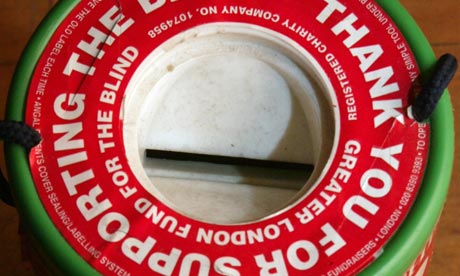
Charity box for the Greater London Fund for the Blind

Medical charities remain the most popular good cause. Photograph: Graham Turner

The amount people give to charity has fallen by 11% in a year because of the recession, a survey revealed today.

The study, by the Charities Aid Foundation and the National Council for Voluntary Organisations, found the average person gave £10 a month to charity during the year to April, £1 a month less than they had donated during the previous 12 months.

The groups said the reduction was equivalent to a £1.3bn drop in the amount of money the UK's 170,000 charities received in real terms.

But despite people giving less, the overall proportion donating money to charities on a monthly basis fell by only 2% to 54%.

Medical charities remain the most popular good cause, with one in five people who made a donation giving money to these organisations, followed by 15% who donated money to hospitals and hospices and 14% who gave money to charities for children and young people.

Just under half the donations were given in cash, with 31% made by direct debit.

But the groups estimate that around £750m is wasted each year through people failing to make a gift-aid declaration, which enables charities to reclaim basic-rate tax paid by the donor on the money.

John Low, chief executive of the Charities Aid Foundation, said: "Even though there are welcome signs the recession is technically ending, the economic downturn is still severely impacting on charities, many of whom have had to cut jobs while facing increased demand for their services.

"If all taxpayers tick the gift-aid box, or give through give-as-you-earn, it would go a long way to make up the shortfall in funding without costing them a penny more."

Typhoon Ondoy Charity Events A Success!


“After the deluge of the terrible storms, there will always be a rainbow, a grander scheme to rebuild new lives.”

The Typhoon Ondoy as you may have seen over the news, destroyed thousands of homes in the very city we live in. That day, I got a phonecall from my sister to ring up emergency numbers to call in Marikina. A friend of hers reported the big Marikina river had swollen and fiercely pushing out to the banks at 10am. Our country has no consolidated 911 emergency response teams, needless to say, there was nothing on the web to call except for the mayor’s office.

As the day unfolded, I recieved text messages from friends, people stranded on top of their roofs, asking to report it online. There were countless stories of being stranded for 18 hours up on rooftops as the floodwaters rushed in their homes in as little as 3 hours. People, cars and trees swimming precariously in floodwaters by the streets. It was mayhem as the rains continued nonstop for 6-or so hours.

RedCrossRescueLogo2

The internet being the only form of communications for some areas (phonelines, mobile was cut off) was a huge aid. Facebook, plurk, twitter updates had helped Filipinos tremendously for calling out volunteers, troops to send out, rubber boats to deploy, updates on victims stranded, missing persons listings. In about 24 hours, private citizens and teams were dispatched to help out those in need. Its such an remarkable feat of unity amidst catastrophe.

Luckily spared from the rains and flooding, albeit the flickering electricity and internet connections, we decided to produce an in-world fundraiser to help out the Philippine Red Cross efforts. Casa del Shai and Straylight Botanical will be contributing 50% of our earnings this two weeks to the cause. Last night the Typhoon Ondoy music event was a huge success. Thanks to my partner and RL husband, Kriss Lehmann, our friends Miabella Foxley and Bethany Heart, we will be donating a total of over $L500,00 to Red Cross this week. Your efforts make you all our internet heroes. We salute you. Thank you all for extending a hand.

If you had missed out on any of our fundraising activities, please take the time to post your personal donations to Red Cross Philippines via bank transfers or Paypal.

Blue Man Group to give typhoon charity show

Blue Man Group, an internationally renowned theater ensemble, arrived in Taipei Aug. 17 to perform for the 21st Summer Deaflympics, including one charity performance for disaster relief in the wake of typhoon Morakot.

Blue Man Group will appear from Aug. 19 to Aug. 23 at the Taipei Arena. The proceeds of an additional charity show at 2:30 p.m. Aug. 20 will be donated to the Red Cross Society of the Republic of China for the purpose of disaster relief.

Brian Scott, a Blue Man Group spokesman, said Blue Man shows are nonverbal, using physical movement, color and creativity. The audience is directly touched by their theatrics, with no need for translation, and this meets the spirit of the Deaflympics, he said.

Emile Chih-jen Sheng, CEO of the Taipei Organizing Committee of the 21st Summer Deaflympics, said he was glad the group is making its first visit to Taiwan for the sports event. He thanked the group for their extra charity performance.

The TOC is considering donating all proceeds from ticket sales to disaster relief, according to Sheng. The disastrous typhoon hit Taiwan hard just as the Deaflympics are around the corner, causing him sadness as well as pressure. Yet the preparatory team would do its best to represent a unified and resilient Taiwan.

In related news, the organizing committee displayed a special set of signal facilities. According to Lin Kuo-jui, TOC chief operations officer, the system of red, yellow and green starting lights will be set up close to athletes in track and field and swimming competitions and will signal hearing-impaired athletes the race has started, just as in Formula 1 racing. (PCT-THN)

Wednesday, October 28, 2009

Thank You All for Participating in the Typhoon Morakot Charity Event!!

Typhoon Morakot Charity Event


Thank you everyone for participating in our Typhoon Morakot Chartiy Event! With your kindness, not only did YoFroyo achieve 3 record selling weekends, but we have accumlated over $30K of donation for the victims of southern Taiwan. Together, the YoFroyo family made a difference!

Children International Donates Typhoon Ketsana Survivors More Than $2.1 Million in Relief

MANILA and QUEZON CITY, Philippines Children International, a U.S.-based humanitarian

organization that helps more than 74,000 poor children in the Philippines, donates $2.1 million in relief to survivors of Typhoon Ketsana.

Items such as food, water, soap, shampoo, sandals, kerosene stoves, sleeping mats and cooking utensils will be distributed to poor families and children that Children International supports. Survivors will also receive funding for basic home repairs and reconstruction, as their homes have been damaged or swept away by floodwaters.

Children International’s President and CEO Jim Cook said, “The children and survivors are in such dire need. They have lost the few meager belongings they own. We are so pleased to provide help to those whose lives have been changed forever by Typhoon Ketsana. The aid will bring some comfort and relief as they rebuild their lives.”


Children in Quezon City are receiving supplies, food, water and clothing after Typhoon Ketsana washes away their few possessions
Familes in Quezon City receive supplies, food, water and clothing after Typhoon Ketsana washes away their possessions.
Over 4,000 poor families supported by Children International have been affected by the massive flood waters.
Over 4,000 poor families supported by Children International
have been affected by the massive flood waters.
This assistance further validates Children International’s title as a leading humanitarian organization in the Philippines for its support of poor children and families there.

Typhoon Ketsana, the worst tropical storm to hit the area in 40 years, has affected over 80 percent of the city’s population including 74,000 children that Children International supports. Early reports estimate over 4,000 Children International-sponsored families have been affected by the Typhoon. The flooding has sadly claimed the life of one child supported by Children International.

To help survivors of Typhoon Ketsana, make a donation at www.children.org/PhilippinesTyphoon.asp today.


About Children International:
Established in 1936, Children International is a nonprofit organization with its headquarters in Kansas City, Missouri. Children International’s programs benefit more than 325,000 sponsored children and their families in 11 countries around the world including Chile, Colombia, the Dominican Republic, Ecuador, Guatemala, Mexico, Zambia, Honduras, India, the Philippines and the United States. For more information about Children International, visit http://www.children.org.

Angel Locsin spearheads an online charity auction for the typhoon victims


JAside from participating in various relief operations, Angel Locsin has found another way to help the victims of Typhoons Ondoy and Pepeng. With the help of Dimples Romana, Anne Curtis, and Kris Aquino, she is currently organizing an online auction to raise more funds for the rehabilitation program of Red Cross. “Anything that's important to them na gusto nilang ishare, it will be up for auction. Tapos 100% of the proceeds will go to the people who were affected by the typhoons,” Dimples said in an interview with Showbiz News Ngayon. “Hindi naman kailangang bags lang. Pwedeng old accessories, jewelry or memorabilia na gusto ninyong idonate. So nag-isip kami ng celebrities na pwedeng lapitan,” Anne added.

This act of kindness on their part is all the more special because they really go out of their way to catalog the items that they have collected from the celebrities who agreed to be part of their cause. Anne further explains, “Si Angel may mga dinonate din siyang bags. Nagdonate din ako pati si Ate Kris. Ate Ruffa (Gutierrez) and Heart (Evangelista) also agreed na magbibigay din sila. Talagang pumupunta kami sa houses ng celebs to take the pics. May kinakausap na nga si Angel para dun sa website where people can bid for the items na available.”

As a matter of fact, Kris will be writing the introduction and the descriptions of their most saleable products on the website. “This is really Angel’s idea. And then she asked me [if I can also contribute], sabi ko, ‘Sure.’ Sabi niya, ‘Pwedeng punta na ako sa house mo?’ and I said, ‘Sure.’ And then she said, ‘Pwedeng pahiram ng maleta?Ako naman, ‘Sure.’ kasi inayos talaga nila yungbags. Dimples’s husband is taking all the pictures using Anne’s camera. And it was Angel, through Red Cross, na nag-ayos para makakuha kami ng Paypal account. Kasi nga we realize that a lot of our TFC viewers would be the ones who are most supportive. So with Paypal makakabili sila at mapapadala ng maayos [yung items] abroad.”

As of press time, Angel was busy distributing relief goods to the victims of Typhoon Pepeng in Pangasinan but she managed to speak about her latest charity work. “Hindi ko ‘to magagawa kung wala sila. Si Anne sobrang nakakaaliw kasi memorize niya lahat ng presyo ng bag. Yung Hermes [na idinonate ko] sobrang mahal ko yung bag na yun. Ipapamana ko sana sa magiging anak ko. Kaya lang siyempre isipin mo, kung gusto mong tumulong, kailangan magsacrifice ka din,” she stated.

Friday, October 23, 2009

Charity


Contents

  • 1 Concepts and practices
  • 2 Organizations
  • 3 Places
  • 4 Entertainment
  • 5 Other
  • 6 External links

Charity may refer to:

Concepts and practices

  • Charity (practice), the practice of benevolent giving,
  • Charity (virtue)
  • Principle of charity in philosophy and rhetoric
  • Tzedakah, the Jewish concept of giving to worthy causes or people in need.
  • Sadaqah, the Arabic concept of alms-giving, often translated as "charity"
  • Altruism
  • Alms

Organizations

  • Charitable organization, a type of non-profit organization formed for charitable purposes
    • 501(c)(3), a specific section of the United States Internal Revenue Code that allows qualifying charitable organizations exemption from federal income tax

Places

  • Charity, Guyana, a small town
  • Charity Island (disambiguation)

Entertainment

  • Charity (play), a play by W. S. Gilbert
  • "Charity" (song), a single by Skunk Anansie
  • Charity (racehorse), a famed racehorse
  • Charity Shea, an actress in the upcoming TV series The Best Years
  • Charity Bazaar, a character from Histeria!
  • An alternate title for the Episode Five of the second series of The Office

Other

  • Charity (name), a given name
  • Charity (programming language), a computer programming language
  • HMS Charity (R29), a British Royal Navy remover-class ship

Charitable organization

A charitable organization is a type of non-profit organization (NPO). The term is relatively general and can technically refer to a public charity (also called "charitable foundation," "public foundation" or simply "foundation") or a private foundation. It differs from other types of NPOs in that its focus is centered around goals of a general philanthropic nature (e.g. charitable, educational, religious, or other activities serving the public interest or common good).

The legal definition of charitable organization (and of charity) varies according to the country and in some instances the region of the country in which the charitable organization operates. The regulation, tax treatment, and the way in which charity law affects charitable organizations also varies.

Contents

  • 1 Australia
    • 1.1 Definition of charity
    • 1.2 Charity law
  • 2 Canada
  • 3 United Kingdom
    • 3.1 England and Wales
      • 3.1.1 Definition of charitable organization
      • 3.1.2 Governing document and trustees
      • 3.1.3 Charitable organization structure
      • 3.1.4 Charity registration
    • 3.2 Northern Ireland
    • 3.3 Scotland
  • 4 United States
    • 4.1 Federal tax relief
  • 5 List of relevant organizations
    • 5.1 Charity regulating bodies
  • 6 See also
  • 7 References

Australia

Definition of charity

The definition of charity in Australia is derived through English common law, originally from the Charitable Uses Act 1601, and then through several centuries of case law based upon it. In 2002, the Federal Government established an inquiry into the definition of a charity. That inquiry proposed that the government should legislate a definition of a charity, based on the principles developed through case law. This resulted in the Charities Bill 2003. The Bill incorporated a number of provisions, such as limitations on charities being involved in political campaigning, which many charities saw as an unwelcome departure from the case law. The government then appointed a Board of the Taxation inquiry to consult with charities on the Bill. As a result of widespread criticism from charities, the Government decided to abandon the Bill.

As a result, the government then introduced what became the Extension of Charitable Purpose Act 2004. This Bill did not attempt to codify the definition of a charitable purpose; it merely sought to clarify that certain purposes were indeed charitable, whose charitable status had been subject to legal doubts. These purposes were: childcare; self-help groups; closed/contemplative religious orders.

Charity law

Under Australian law, there is no centralized system of government regulation or recognition for charities. The notion of a charity touches upon several distinct areas of the law; it is up to each individual agency to decide on what is a charity with respect to the laws it is administering. If an entity disagrees with the decision of the agency, it can challenge it through the Courts. It is possible for an entity to be recognized as a charity by some agencies but not others. For example, in the early 1980s, Scientology was recognized as a religious charity by the governments of most States and Territories, but the Victorian taxation system refused recognition, until Scientology successfully challenged that decision through the courts - see Church of the New Faith for more.

The most important of the laws around charities is the registration with the Australian Taxation Office as deductible gift recipients (DGR). This results in the people being able to deduct donations to the charity from their income tax. However, there are also several other areas where charity comes into play: the States regulate charitable fundraising, to ensure only bona fide charities engage in it; ASIC charges reduced fees for companies established for a charitable purpose; charities can avail themselves of exceptions to the company naming provisions under the Corporations Act; trusts for charitable purposes can escape the rule against perpetuities in trust law.

Canada

Charities in Canada must be registered with the Canada Revenue Agency, a department of the ministry of finance. According to the Canada Revenue Agency:

A registered charity is an organization established and operated for charitable purposes, and must devote its resources to charitable activities. The charity must be resident in Canada, and cannot use its income to benefit its members. A charity also has to meet a public benefit test. To qualify under this test, an organization must show that:

  • its activities and purposes provide a tangible benefit to the public
  • those people who are eligible for benefits are either the public as a whole, or a significant section of it, in that they are not a restricted group or one where members share a private connection, such as social clubs or professional associations with specific membership
  • the charity's activities must be legal and must not be contrary to public policy
To register as a charity, the organization has to be either incorporated or governed by a legal document called a trust or a constitution. This document has to explain the organization's purposes and structure.

United Kingdom

England and Wales

Definition of charitable organization

A charity, or charitable organization, in England and Wales is a particular type of voluntary organization. A voluntary organization is an organization set up for charitable, social, philanthropic or other purposes. It is required to use any profit or surplus only for the organization's purposes, and it is not a part of any governing department, local authority or other statutory body. All charities are voluntary organizations, but not all voluntary organizations in England and Wales are charities.

For a voluntary organization to be a charitable organization or charity, its overall goals, sometimes called the “purposes” of the organization, must be charitable. All the purposes of the organization must be charitable, as a charity cannot have some purposes which are charitable and some which are not. The Charities Act 2006 provides the following list of charitable purposes.

  1. the prevention or relief of poverty
  2. the advancement of education
  3. the advancement of religion
  4. the advancement of health or the saving of lives
  5. the advancement of citizenship or community development
  6. the advancement of the arts, culture, heritage or science
  7. the advancement of amateur sport
  8. the advancement of human rights, conflict resolution or reconciliation or the promotion of religious or racial harmony or equality and diversity
  9. the advancement of environmental protection or improvement
  10. the relief of those in need, by reason of youth, age, ill-health, disability, financial hardship or other disadvantage
  11. the advancement of animal welfare
  12. the promotion of the efficiency of the armed forces of the Crown or of the police, fire and rescue services or ambulance services
  13. other purposes currently recognised as charitable and any new charitable purposes which are similar to another charitable purpose.

A charity must also provide a public benefit.

Before the Charities Act 2006 the definition of charity arose from a list of charitable purposes in the Charitable Uses Act 1601 (also known as the Statute of Elizabeth), which had been interpreted and expanded into a considerable body of case law. In Commissioners for Special Purposes of Income Tax v Pemsel (1891), Lord McNaughten identified four categories of charity which could be extracted from the Charitable Uses Act and which were the accepted definition of charity prior to the Charities Act 2006.

  1. the relief of poverty,
  2. the advancement of education,
  3. the advancement of religion, and
  4. other purposes considered beneficial to the community.

Governing document and trustees

The governing document of a charity means the document that sets out the charity's purposes and usually, how it is to be administered. Depending on the legal structure of the charity, this document may be a constitution, a trust deed, a memorandum and articles of association, or some other formal document. The charity trustees are the people who, as specified in the charity's governing document, are responsible for the general control and management of the charity. In the charity's governing document they may be called trustees, managing trustees, committee members, governors, or directors, or they may be referred to by some other title.[9]

Recent government legislation, passed by the Cabinet Office, intends to change the structure of Charitable Incorporated Organisations(CIOs). It will enable CIOs to benefit from a multitude of advantages.

Charitable organization structure

In 2008 there are a number of types of legal structure for a charity in England and Wales.

  1. Unincorporated association
  2. Trust
  3. Company limited by guarantee
  4. Another incorporation, such as by Royal Charter

The unincorporated association is the most common form of organization within the voluntary sector in England and Wales. An unincorporated association is essentially a contractual arrangement between individuals who have agreed to come together to form an organization for a particular purpose. An unincorporated association will normally have as its governing document, a constitution or set of rules, which will deal with such matters as the appointment of office bearers, and the rules governing membership. The organization is not though a separate legal entity. So it cannot start legal action, it cannot borrow money, and it cannot enter into contracts in its own name. Also the officers can be personally liable if the charity is sued or has debts.

A Trust is essentially a relationship between three parties, the donor of some assets, the trustees who hold the assets and the beneficiaries (those people who are eligible to benefit from the charity). When the trust has charitable purposes, and is a charity, the trust is known as a charitable trust. The governing document is the Trust Deed or Declaration of Trust, which comes into operation once it is signed by all the trustees. The main disadvantage of a trust is that, as with an unincorporated association, it does not have a separate legal entity and the trustees must themselves own property and enter into contracts. The trustees are also liable if the charity is sued or incurs liability.

A company limited by guarantee is a private limited company where the liability of members is limited. A guarantee company does not have a share capital, but instead has members who are guarantors instead of shareholders. In the event of the company being wound up the members agree to pay a nominal sum which can be as little as £1. A company limited by guarantee is a useful structure for a charity where it is desirable for the Trustees to have the protection of limited liability. Also, the charity has a clear legal identity, and so can enter into contracts, such as employment contracts in its own name.

A small number of charities is incorporated by Royal Charter, a document which creates a corporation with legal personality (or, in some instances, transforms a charity incorporated as a company into a charity incorporated by Royal Charter). The Charter must be approved by the Privy Council before receiving Royal Assent. Although the nature of the charity will vary depending on the clauses enacted, generally a Royal Chartered will offer a charity the same limited liability as a company and the ability to enter into contracts.

The Charities Act 2006 introduced a new legal form of incorporation designed specifically for charities, the Charitable Incorporated Organisation. This is not yet available for charities to use.

The word Foundation is not generally used in England and Wales. Occasionally a charity will use the word Foundation as part of its name e.g. British Heart Foundation, but this has no legal significance and does not provide any information about either the work of the charity or how it is legally structured. The structure of the organization will be one of the three types of structure described above.

Charity registration

Charitable organizations who have an income of more than £5,000, and for whom the law of England and Wales applies, must register with the Charity Commission for England and Wales. For companies, the law of England and Wales will normally apply if the company itself is registered in England and Wales. In other cases if the governing document does not make it clear, the law which applies will be the country with which the organization is most connected.

Where an organization's income does not exceed £5,000 it is not able to register as a charity with the Charity Commission for England and Wales. It can, however, register as a charity with HM Revenue and Customs. With the rise in mandatoty registration level, to £5,000 by the The Charities Act 2006, smaller charities can be reliant upon HMRC recognition to evidence their charitable purpose and confirm their not-for-profit principles.

Some charities which are called exempt charities are not required to register with the Charity Commission and are not subject to any of the Charity Commission's supervisory powers. These charities include most universities and national museums and some other educational institutions. Other charities are excepted from the need to register, but are still subject to the supervision of the Charity Commission. The regulations on excepted charities have however been changed by the Charities Act 2006. Many excepted charities are religious charities.

Northern Ireland

The 5,000 or so charities in Northern Ireland are registered with the Inland Revenue. There is no central register or regulatory body for these charities, but this situation is currently under discussion.

Scotland

The 20,000 or so charities in Scotland are registered with the Office of the Scottish Charity Regulator (OSCR), which also publishes a Register of charities online. Scotland has the highest number of charities in the world compared to its people ratio.

United States

In the United States a charitable organization is an organization that is organized and operated for purposes that are beneficial to the public interest, however a distinction is made between types of charitable organizations.

Every U.S. and foreign charity that qualifies as tax-exempt under Section 501(c)(3) of the Internal Revenue Code is considered a "private foundation" unless it demonstrates to the IRS that it falls into another category. In a general sense, any organization that is not a private foundation (i.e. it qualifies as something else) is usually a public charity as described in Section 509(a) of the Internal Revenue Code.

In addition, a private foundation usually derives its principal fund from an individual, family, corporation, or some other single source and is more often than not a grantmaker and does not solicit funds from the public. In contrast, a foundation or public charity generally receives grants from individuals, government, and private foundations and although some public charities engage in grantmaking activities, most conduct direct service or other tax-exempt activities.

This leads to another distinction: Foundations that are generally grantmakers (i.e. they use their endowment to make grants to other organizations, which in turn carry out the goals of the foundation indirectly) are usually referred to as "grantmaker" or "non-operating" foundations. These of course tend to be private foundations. Some private foundations however, (and most public charities) use their received funds to directly engage in service activities themselves and achieve their goals "personally," so-to-speak.

Examples of a non-operating private foundation would be the Rockefeller Foundation and the Bill & Melinda Gates Foundation.

Examples of operating foundations or public charities include the Elizabeth Glaser Pediatric AIDS Foundation, American Cancer Society, Inc., and the World Wildlife Fund.

The requirements and procedures for forming charitable organizations vary from state to state, as do the registration and filing requirements for charitable organizations that conduct charitable activities or solicit charitable contributions. So effectively in practice the detailed definition of charitable organization is determined by the requirements of state law of the state in which the charitable organization operates, and the requirements for federal tax relief set by the IRS.

Federal tax relief

Federal tax law provides tax benefits to non profit organizations recognized as exempt from federal income tax under section 501(c)(3) of the Internal Revenue Code (IRC). The benefits of 501(c)(3) status include exemption from federal income tax as well as eligibility to receive tax deductible charitable contributions. To qualify for 501(c)(3) status most organizations must apply to the Internal Revenue Service (IRS) for such status.

There are several requirements that must be met for a charitable organization to obtain 501(c)(3) status. These include the organization being organized as a corporation, trust, or unincorporated association, and the organization’s organizing document (such as the articles of incorporation, trust documents, or articles of association) must limit its purposes to being charitable, and permanently dedicate its assets to charitable purposes. The organization must refrain from undertaking a number of other activities such as participating in the political campaigns of candidates for local, state or federal office, and must ensure that its earnings do not benefit any individual.

The types of charitable organization that are considered by the IRS to be organized for the public benefit include those that are organized for:

  1. Relief of the poor, the distressed, or the underprivileged,
  2. Advancement of religion,
  3. Advancement of education or science,
  4. Erection or maintenance of public buildings, monuments, or works,
  5. Lessening the burdens of government,
  6. Lessening of neighborhood tensions,
  7. Elimination of prejudice and discrimination,
  8. Defense of human and civil rights secured by law, and
  9. Combating community deterioration and juvenile delinquency.

A number of other organizations, including those organized for religious, scientific, literary and educational purposes, as well as those for testing for public safety and for fostering national or international amateur sports competition, and for the prevention of cruelty to children or animals, may also qualify for exempt status.

The IRS, except in rare circumstances, refers to all organizations qualifying for exemption under 501(c)(3) as charities.

List of relevant organizations

Charity regulating bodies

  • Australian Taxation Office
  • Canada Revenue Agency
  • Inland Revenue Department (Hong Kong)
  • Public Trustee (Ontario)
  • Charity Commission for England and Wales
  • Office of the Scottish Charity Regulator
  • United States Internal Revenue Service

See also

  • Charitable trust
  • Cy pres doctrine
  • Foundation
  • Governance
  • Grants
  • Non-profit organization
  • Philanthropy
  • Social enterprise
  • List of charities accused of ties to terrorism